
If you’ve sat in any boardroom, business hub, or strategy session in South Africa over the last eighteen months, the topic is unavoidable: Artificial Intelligence.
We have all been wowed by Generative AI (Gen AI). We’ve seen platforms write marketing copy in seconds, generate images from thin air, and summarize 50-page documents into three bullet points. It’s impressive tech.
But now that the initial hype is settling, I’m hearing a very practical, very South African question coming from leaders on the ground—from corporate executives in Sandton to founders of mid-sized logistics firms in Durban:
“Okay, Ashley, it can write a nice email. But can it actually run my operations? Can it help me cut costs and serve my customers better?”
The short answer is: No, Gen AI alone cannot do that.
But the good news is that AI is evolving fast. We are moving past the phase of just creating content and entering a new era of taking action.
This is the shift to Agentic AI. And for African businesses looking for efficiency and a competitive edge, this changes everything.
The Big Picture: Understanding the Evolution
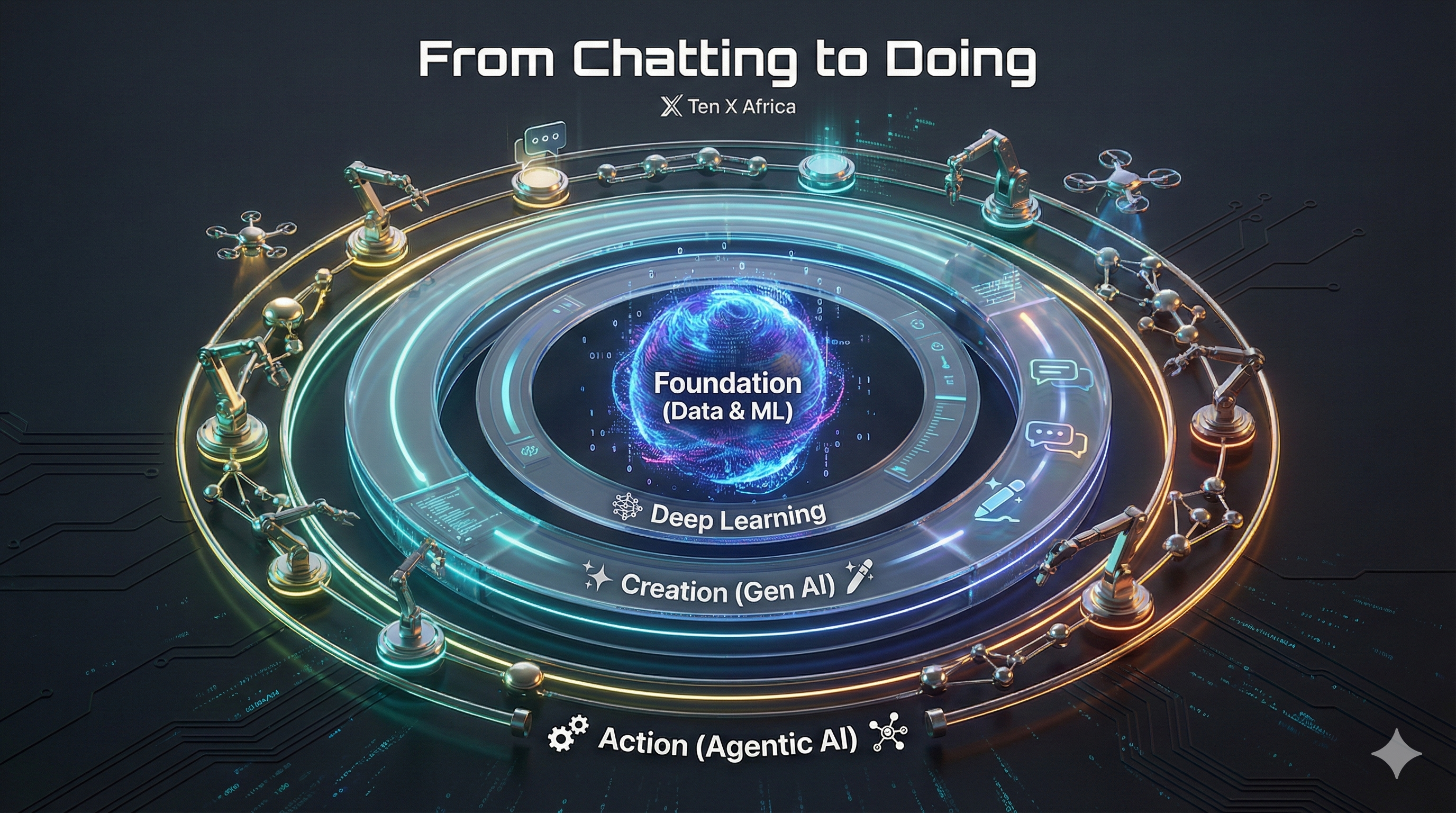
At Ten X Africa, we spend a lot of time demystifying technology. The easiest way to understand where we are going is to look at where we’ve come from. Think of AI as having layers, like an onion.
The Foundation (Data & ML): At the core, we have the older tech. This is about crunching numbers to spot patterns. It helps banks spot fraud or retailers predict what stock to order. It’s about analyzing.
The Creative Layer (Gen AI): This is where most businesses are stuck right now. It’s your ChatGPTs. It’s brilliant at understanding language and creating new things based on prompts.
The Action Layer (Agentic AI): This is the outer ring, and the future of business automation. This is where AI stops just “chatting” and starts doing.
The Difference Between a Chatbot and an Agent
To make this practical, let’s look at a typical South African business challenge: supply chain management.
If you ask a current Gen AI chatbot: “Where is shipment #123?”
It will look up a database and tell you: “Shipment #123 is currently delayed in Cape Town.”
That’s helpful information, but you still have a problem. You still have to pick up the phone, call the courier, re-book the slot, and email the unhappy customer.
Now, imagine an AI Agent handling this.
An AI Agent doesn’t just sit and wait for a prompt. It is given a goal: “Ensure on-time delivery.”
When it sees a delay, the Agent doesn’t just report it. It autonomously logs into your logistics provider’s portal to find alternative routes, it sends an updated schedule to your warehouse team, and it proactively emails the client with the new ETA—all without a human having to intervene.
Gen AI talks about the work.
Agentic AI does the work.
Agents can plan, they can use tools (like your accounting software or CRM), they remember context, and they execute complex tasks across different systems.
Leveling the Playing Field for SMMEs and Mid-Sized Players
For a long time, serious automation was a luxury only the biggest corporates could afford. It required massive IT departments and expensive, multi-year implementation projects.
Agentic AI is democratizing this.
This technology allows lean teams in mid-sized companies to operate with the efficiency of a massive enterprise. It allows an SMME in the fintech space to automate their compliance checks, or a growing retailer to automate their entire customer service workflow across WhatsApp and email.
This is crucial for opening up those “blue oceans”—new markets where efficiency and speed give you the advantage over slow-moving incumbents.
The Opportunity for Africa
In Africa, we are famous for “leapfrogging” older technologies. We did it with landlines and moved straight to mobile. We have a massive opportunity to do the same here.
We don’t need to get bogged down in the legacy systems of the past. We can move straight to adopting intelligent agents that automate our core business processes.
At Ten X Africa, our mission isn’t just to serve the JSE Top 40. It’s to make this powerful technology accessible to the businesses that are truly driving our economy forward. Whether you need to streamline governance in a large corporate or automate operations in a high-growth mid-sized firm, the goal is the same: stop just talking about AI, and start putting it to work.
Let’s move from chatting to doing.